
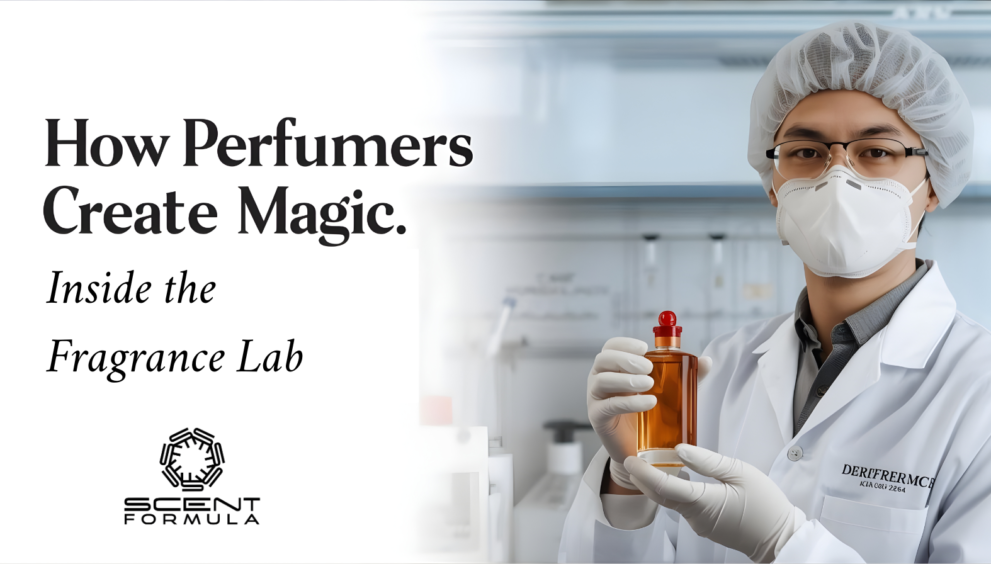
How Perfumers Create Magic: Inside the Fragrance Lab

Did you know the global perfume industry is worth over $30 billion and keeps growing? It’s not just about selling scents; it’s about making magic. Perfumers are the artists who mix the art of perfumery with chemistry to delight your senses.
In a fragrance lab, they turn simple ingredients into the amazing smells that change our moods, bring back memories, and show who we are. Let’s explore the detailed steps and creativity that turn each perfume bottle into a work of art.

Key Takeaways
- Perfumers blend creativity and science in the fragrance lab.
- The global perfume industry is a multibillion-dollar market.
- Fragrance creation involves detailed processes from concept to completion.
- Each scent perfume has the power to evoke emotions and memories.
- The art of perfumery celebrates both natural and synthetic ingredients.
The Unique Blend of Art and Science in Perfumery
Perfume creation is a mix of art and science. It balances creativity with precision. This ensures each fragrance is a unique masterpiece.
In perfume making, it’s more than just mixing ingredients. It’s like an artist choosing colours to evoke feelings and memories. The perfumer’s skill is in blending these scents perfectly, creating fragrances that stay with you.
The science behind fragrance is key. Chemistry helps break down complex scents and understand how they interact. This knowledge lets perfumers predict how a fragrance will change over time, keeping it pleasant and stable.
This mix of art and science makes perfume a personal experience. Each fragrance is designed to connect with its wearer, forming a deep bond.
Perfumers use their artistry and scientific knowledge to create amazing scents. These scents become a big part of our lives.
The Role of Natural and Synthetic Ingredients in Fragrance Creation
Fragrance making is a complex art. It blends natural ingredients with synthetic ones. This mix creates the scents that delight us and bring back memories. Let’s explore how these parts shape the world of perfumery.
Natural Ingredients
Natural ingredients, like essential oils from flowers and spices, add depth to scents. They change over time, offering a unique smell that shifts with your skin. Using natural ingredients connects you to the earth, bringing nature’s essence to your senses.

Synthetic Ingredients
Synthetic ingredients are key for scent stability and variety. They mimic or create new fragrances, expanding the perfumer’s options. This mix of natural and synthetic ingredients gives you a wide range of scents, enhancing your sensory experiences.
| Ingredient Type | Characteristics |
|---|---|
| Natural Ingredients | Complex, evolving, earthly |
| Synthetic Ingredients | Consistent, varied, innovative |
The Journey of Fragrance Creation: From Concept to Completion
The journey of creating a fragrance starts with a vision. It ends with a product that delights our senses. From concept to completion, each step is vital. It combines creativity with market needs, making the fragrance stand out.
The Fragrance Brief
The fragrance brief is where it all begins. It’s like a blueprint for the scent we want. It outlines who the fragrance is for, the mood it should create, and key ingredients. This sets the tone for the entire perfume development journey.
Market Research and Development
After the brief, market research follows. It checks if the scent fits what people like and if it’s unique. This stage looks at competitors and finds gaps in the market. It helps shape the fragrance’s identity in the fragrance industry.
From idea to reality, perfume development requires testing and tweaking. Perfumers mix different scents, adjusting them until it’s just right. This ensures the fragrance is both new and appealing to buyers.
Understanding Fragrance Structure: Top, Middle, and Base Notes
Fragrance structure is like a symphony with layers. Each layer has its own role, blending together for a lasting scent. Knowing about top, middle, and base notes is key to enjoying or making perfumes.
Top Notes
The first thing you smell in a perfume are the top notes. These are light and fade fast, giving an instant scent. They’re often fresh and light, like citrus or herbs.
Middle Notes
After the top notes fade, the middle notes come in. They’re the heart of the perfume, adding depth and character. They include heavier scents like spices and fruits, making a smooth transition to the base notes.
Base Notes
Base notes are the scent’s foundation, lasting long and deep. They appear after the middle notes, supporting the whole fragrance. They’re rich, like woods and musks, leaving a lasting impression.

| Layer | Description | Examples |
|---|---|---|
| Top Notes | Initial, light, and fleeting | Citrus, Herbs, Light Florals |
| Middle Notes | Core “heart” of the fragrance | Heavier Florals, Spices, Fruits |
| Base Notes | Long-lasting foundation | Woods, Resins, Musks |
Exploring Raw Materials Used in Perfumery
In the world of perfumery, choosing raw materials is key. They help create unique and memorable scents. Each part, from essential oils to synthetic components, adds its own special touch.

Essential Oils
Essential oils come from plants and are essential in perfumery. They give natural and rich smells. Lavender, rose, and citrus oils are favourites for their freshness and vibrant scents.
Resins and Spices
Resins and spices add warmth and depth to perfumes. They come from plants and trees. Frankincense and myrrh give a balsamic smell, while cinnamon and cardamom add exotic and aromatic notes.
Synthetic Components
Synthetic components are a modern twist in perfumery. They help create unique scents not found in nature. These raw materials are made to enhance or replicate natural smells, making perfumes consistent and stable. They open up new possibilities in fragrance creation.
Critical Tools and Equipment in a Fragrance Lab
Every fragrance lab has essential tools for making perfumes. These tools include glassware for mixing scents, pipettes and funnels for precise liquid transfer, and storage bottles to keep fragrances safe. Each tool is vital for creating high-quality fragrances.
Glassware
High-quality glassware is key for measuring and mixing fragrance components. Beakers, graduated cylinders, and flasks are made to handle different chemical reactions. This ensures your fragrances stay pure and consistent.
Pipettes and Funnels
Pipettes and funnels are crucial in a fragrance lab. Pipettes help transfer small amounts of liquid accurately, preventing spills. Funnels make transferring larger amounts easy, so no fragrance is wasted.
Storage Bottles
Storage bottles keep your fragrance blends stable and fresh. They are made to block light and reduce air exposure. This helps preserve the scent of your oils and ingredients, keeping fragrances perfect over time.
Knowing how each tool in a fragrance lab works helps us appreciate the art of scent creation. With the right tools, from glassware to storage bottles, you can make fragrances that are of the highest quality.
Precision in Measurement and Mixing Techniques
The world of perfume making needs perfect attention to detail. Precision measurement is essential, making sure each part adds just the right touch. This careful work keeps the scent consistent in every batch.
In the lab, mixing techniques are key. Every step, from the first mix to the final blend, requires skill. This mix of old and new methods creates the perfect scent.

Creating perfume is a detailed process. It begins with choosing top-quality ingredients. Then, it moves to precise measurements and ends with mixing techniques that make a unique scent. Brands like Chanel and Dior set high standards, focusing on accuracy and consistency.
Here’s a look at what’s important in perfume manufacturing:
| Technique | Importance | Applications |
|---|---|---|
| Precision Measurement | Ensures exact component ratios | Used in dosage, blending, and quality control |
| Mixing Techniques | Homogenises ingredients | Employed in initial blending and final refinement |
| Maceration | Develops fragrance depth | Applies post-mixing for maturation |
Knowing how important these steps are helps us see the skill in every fragrance. Whether it’s about precise measurement or advanced mixing, perfume making shows the dedication and talent of the creators.
The Art and Science of Ageing and Maceration
Making a fine perfume is more than just mixing ingredients. It involves steps like ageing and maceration. These steps are key to getting the right mix of scents. Let’s look at how maturation, dilution, and bottling work together.

Maturation Process
The ageing process lets the scents blend and grow over time. It’s important for deepening the perfume’s smell. The perfume is kept in glass to prevent any bad changes, letting it age well.
Dilution Techniques
After ageing, the perfume is diluted. This means adding alcohol or solvents to get the right strength. Dilution makes the perfume strong enough to smell good but not too strong.
Final Filtering and Bottling
The last step is filtering and bottling. The perfume is filtered to get rid of any bad stuff. Then, it’s put in fancy bottles that keep the scent good and make it look nice. Each bottle is sealed and ready for someone to enjoy.
| Process | Purpose | Outcome |
|---|---|---|
| Ageing Process | To enhance depth and harmony | Fully developed fragrance notes |
| Dilution Techniques | To balance concentration | Wearable and balanced scent |
| Final Filtering and Bottling | To remove impurities and package | Clear and pristine fragrance in elegant bottles |
Evaluating and Adjusting Perfume Compositions
In the world of perfumery, checking perfume is very detailed. It makes sure the fragrance is top-notch. Perfumers carefully check and change each part until it’s just right. This makes sure every scent meets high standards.

- Sensory Analysis: Perfumers use their noses to understand scents.
- Panel Testing: A group tries the perfume to see if it’s liked by many.
- Stability Tests: These check how the scent lasts over time and in different places.
After checking, the next step is to adjust the perfume. Perfumers might add or take away ingredients to get the right mix. This is key to making a scent that’s perfect and shows off the brand’s quality.
| Aspect | Analysis | Adjustment |
|---|---|---|
| Aromatic Balance | Sensory testing shows some notes are too strong | Change the mix to get a better balance |
| Longevity | Tests show the scent doesn’t last long | Add fixatives to make it last longer |
| Projection | People say the scent doesn’t spread well | Change some parts to make it spread better |
| Market Appeal | Feedback says the scent isn’t liked by the target group | Change it to make it more appealing |
This careful process makes every perfume bottle special. It shows the skill and detail that goes into making a great fragrance. Checking and adjusting perfume is crucial for creating scents that are loved by all.
Perfumers Create Magic: Inside the Fragrance Lab, Unveiling the Secrets
Step into the world of fragrance creation. Here, expert perfumers mix science and art to make magical scents. Your visit to the fragrance lab is a journey of discovery. You’ll learn how each perfume is crafted with care.
The Fragrance Lab Experience
In the fragrance lab experience, you see the skill and creativity in perfume making. Guests go through interactive stations to learn about the fragrance creation process. Perfumers show how they pick and blend ingredients with special tools.

Guest Engagement in Fragrance Creation
Perfumers want to make the process of creating a perfume clear to guests. They offer interactive workshops. Here, you can mix different notes to see how they work together. This hands-on learning makes the experience unforgettable.
Conclusion
The world of perfumery is a magical mix of art and science. Exploring scents shows how each fragrance is made with care and love. The process, from picking raw materials to mixing, shows the skill needed in perfumery.
Knowing about natural and synthetic ingredients and the structure of scents is key. It shows the artistry behind each perfume. Every step, from the first idea to the final touches, shows the dedication to making perfumes.
In short, perfumery is not just about nice smells. It’s about creating a special experience that links memories and feelings. The people who make these scents work hard to bring them to life. Enjoying these fragrances means appreciating the art and science behind them.
To get more updates and insights about perfumes, visit https://scentformula.sg
Frequently Asked Questions
How do perfumers begin to create a scent and what is the first step in perfume making?
The creative process usually starts with inspiration — a memory, a place, a floral bouquet or a single aroma like jasmine. Perfumers at a fragrance house sketch a brief, then select perfume ingredients and perfume oils to create a signature scent. They rely on a deep understanding of olfactory families and notes to map out top, heart and base accords before they start blending.
What extraction methods do perfumers use to get raw materials from a plant source?
Perfumers use many extraction methods such as solvent extraction, steam distillation, enfleurage, and CO2 extraction to obtain an extract or absolute from plant material. Some materials cannot be extracted directly and require synthetic aromatic compounds. Grasse and other traditional scent regions still favor certain artisanal techniques for delicate floral extracts.
What’s the difference between perfume oils, fragrance oils, and an eau de parfum in perfume manufacturing?
Perfume oils and fragrance oils are concentrated blends of aromatic compounds and can be natural or synthetic. Eau de parfum is a finished product diluted with alcohol and water to a specific concentration, which affects how long the aroma will captivate you before it starts to evaporate. The choice depends on the art and science of fragrance and the intended market, from artisanal small-batch to mass production.
How do perfumers compose fragrance notes to create depth and complexity?
Perfumers layer notes — top, heart (often floral or aromatic), and base — to build a well-rounded scent. They select ingredients to achieve balance and ensure some notes help others linger. A meticulous blender understands how aromatic compounds interact, which allows them to create a perfume with depth and complexity that evolves on the skin.
Can you explain how bespoke fragrance and artisanal perfumery differ from commercial perfume production?
Bespoke fragrance is a personalized, often artisanal, process where a perfumer crafts a signature scent for one person, using selected fragrance ingredients and tailored blends. Commercial perfumers work at perfume houses focusing on scalability, cost, and consistency, which affects choices in raw materials and extraction methods during perfume production.
Why do some scents smell different on different people — is it all about the olfactory system?
Yes, the sense of smell and skin chemistry play huge roles. Body oils, pH, diet and even medications change how an aroma unfolds. Perfumers who create a perfume know the importance of testing on many skin types to ensure the fragrance reads well across different people and remains true to the intended composition.
What role do synthetic aromatic compounds play in modern perfumery and creating materials that cannot be sourced naturally?
Synthetic aromatic compounds allow perfumers to recreate rare or unstable scents, fill gaps where plant material is scarce, and stabilize a formula for perfume storage and mass production. Solvent extraction and synthetic alternatives are essential for materials that cannot be harvested sustainably, and they expand the palette for creative expression.
How important is packaging, like the bottle of perfume, in showcasing the art of perfume?
The bottle of perfume and packaging are part of the storytelling — they protect the fragrance from light and oxygen that can make it evaporate or degrade, and they signal the brand’s aesthetic. For artisanal or luxury fragrance houses, design complements the olfactory artistry and helps the perfume connect emotionally with the wearer.
What does the future of perfumery look like — new ingredients, tech, or trends?
The future of perfumery blends sustainability, biotech and creativity. Expect more lab-grown naturals, greener extraction methods, AI-assisted formulation, and evolving olfactory trends. Fragrance experts are balancing tradition with innovation to create new notes to create modern classics while addressing supply-chain and environmental concerns.
You may also check out the page of Urban Perfumery to see “BEHIND THE SCENES: HOW PERFUMES ARE MADE“