
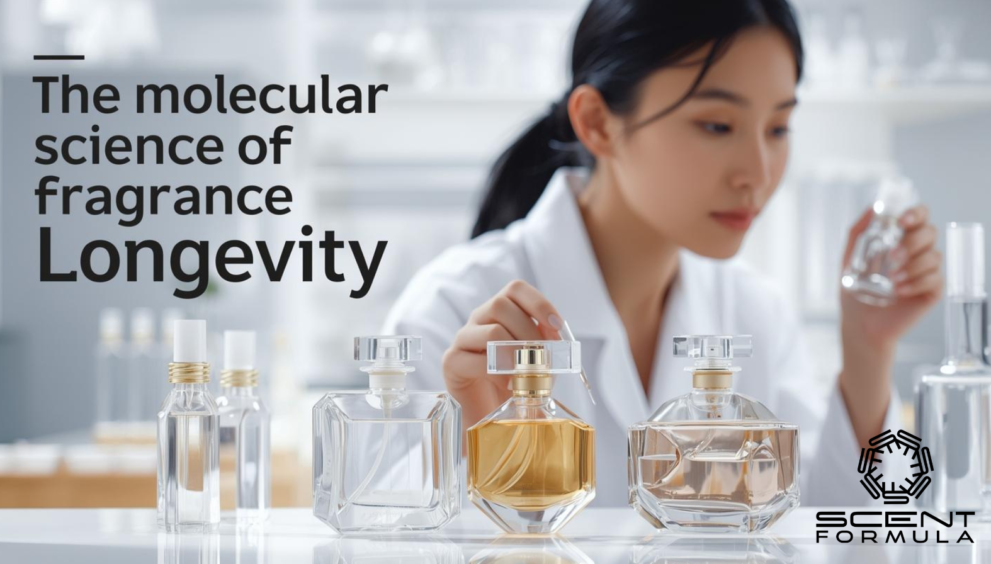
The Molecular Science of Fragrance Longevity

Did you know that about 30% of a fragrance’s performance comes from its molecular structure? This fact shows how closely molecular science and fragrance longevity are linked. When you explore the world of perfume, knowing how molecular interactions affect scent longevity is key. Things like chemical makeup, skin chemistry, and the environment all influence how long a fragrance lasts.
By learning more about these scientific principles, you can choose fragrances that make a lasting impression. This knowledge helps you pick scents that stay with you longer.

Key Takeaways
- The molecular structure fundamentally affects fragrance longevity.
- Understanding the composition of fragrances can enhance your scent experience.
- Skin chemistry significantly impacts how long a fragrance lasts.
- Environmental factors like temperature and humidity can alter scent retention.
- Your choice of perfume type affects longevity and strength.
The Importance of Fragrance Longevity
Understanding fragrance longevity is key in perfumery. It makes your scent experience better. A long-lasting fragrance leaves a lasting impression, important in both personal and professional life. Choosing perfumes that last longer lets you keep a scent that reflects your identity.
Why Fragrance Longevity Matters in Perfumery
Fragrance longevity is crucial for a perfume’s performance all day. Long-lasting scents keep your fragrance present, making you feel confident and refreshed. This aspect of perfume longevity affects how others see your scent, enhancing its impact and your self-expression.
Personalising Your Scent Experience
Personalising your scent starts with knowing how fragrances change over time. Choosing scents that last longer helps you find the right one for your lifestyle. As you try different fragrances, pick ones that show your character and preferences. This way, you can improve your daily interactions with a scent that suits you.
Chemical Composition and Its Role in Scent Longevity
The makeup of a fragrance greatly affects how long it lasts and how it smells on the skin. Different scents have unique compounds that decide their longevity. Knowing the concentration of these compounds helps us understand the differences between fragrances like parfum, eau de toilette, and eau de cologne.
Aromatic Compound Concentration
More aromatic compounds mean a scent lasts longer. For instance, parfum, with 15-20% fragrance, leaves a lasting impression. On the other hand, eau de toilette, with 5-15%, fades faster. Eau de cologne, the lightest, has 2-5% compounds, making its scent brief.
Differences between Parfum, Eau de Toilette, and Eau de Cologne
Knowing the differences between these fragrances helps you pick one that lasts as long as you want. Here’s a quick comparison:
| Fragrance Type | Fragrance Concentration (%) | Longevity (Hours) |
|---|---|---|
| Parfum | 15-20% | 5-8 |
| Eau de Toilette | 5-15% | 3-5 |
| Eau de Cologne | 2-5% | 2-3 |

By understanding these differences, you can choose a fragrance that fits your preferences and needs. This ensures a more enjoyable scent experience.
The Molecular Science, Fragrance Longevity, Scent, Perfume, Perfumery, Liquid Scent
The science behind how long a fragrance lasts is all about the molecules. It’s key to know how these molecules act. This is especially true when comparing fast-evaporating volatile parts to the lasting non-volatile parts. How these molecules react with your skin is crucial.
Understanding Fragrance Molecules
Fragrance molecules are the heart of any scent. They’re designed to bring out certain feelings or memories. Each molecule’s unique traits affect how it interacts with others. Knowing what molecules are in your perfume can explain why some fragrances last longer on you.
The Interaction of Scent Molecules with Skin Chemistry
How scent molecules interact with your skin chemistry greatly affects how long a fragrance lasts. Everyone’s skin is different, with varying pH levels, skin types, and moisture. These differences change how scent molecules evaporate, leading to unique fragrance experiences. For example, a perfume might smell strong on one person but softer on another.
| Skin Type | Effect on Fragrance Longevity |
|---|---|
| Oily Skin | Tends to hold fragrance molecules longer, resulting in prolonged scent retention. |
| Dry Skin | May cause fragrance molecules to evaporate more quickly, leading to faster scent loss. |
| Combination Skin | Fragrance longevity can vary based on the area of application and humid conditions. |
By understanding these interactions, you can pick fragrances that suit your skin better. This can greatly improve your fragrance experience.
Oil Concentrations in Perfumes
The amount of oil in perfumes greatly affects how long they last. Scents with more oil stay on your skin longer. It’s key to know the oil concentration when picking fragrances.
The Role of Higher Oil Concentration in Longevity
Perfumes called Parfum have 20% to 40% oil. This means they can last over 12 hours. On the other hand, Eau de Cologne has only 2% to 5% oil. These lighter scents fade quickly, lasting just a few hours.
Comparative Analysis of Oil Concentrations
The table below shows how different fragrances compare in oil concentration and longevity:
| Fragrance Type | Oil Concentration (%) | Longevity (Hours) |
|---|---|---|
| Eau de Cologne | 2 – 5 | 2 – 4 |
| Eau de Toilette | 5 – 15 | 4 – 6 |
| Eau de Parfum | 15 – 20 | 6 – 8 |
| Parfum | 20 – 40 | 12+ |
Looking at these oil levels helps you choose fragrances that last all day. This ensures you enjoy your scent all day long.

Effects of Skin Type on Perfume Longevity
Perfume longevity is greatly affected by your skin type. Knowing how your skin type interacts with fragrance can improve your scent experience. Oily and dry skin types have different effects on fragrance retention, so it’s key to understand these differences when choosing a scent.
How Oily Skin Retains Fragrance Better
Oily skin is better at keeping fragrances than dry skin. The oils in your skin help keep scent molecules locked in, making fragrances last longer. This means your perfume will stay strong and intense all day.
Dry Skin and Its Challenges with Scent Retention
On the other hand, dry skin has trouble keeping fragrances. Without moisture, scent molecules evaporate fast, shortening fragrance life. To help, moisturise your skin before applying perfume. This keeps your skin hydrated and helps the fragrance stick better, enhancing your scent experience.
| Skin Type | Fragrance Retention | Best Practices |
|---|---|---|
| Oily Skin | High retention | Apply directly on skin |
| Dry Skin | Low retention | Moisturise before application |
Environmental Factors Influencing Scent Longevity
Understanding how the environment affects fragrance longevity can improve your scent experience. Temperature and humidity are key in how fragrances last. Knowing this helps you pick and apply perfumes better, making your scent last longer.
The Impact of Temperature and Humidity on Fragrance Evaporation
Temperature greatly affects how fast fragrances evaporate. Warmer temperatures speed up the evaporation of fragrance molecules. This means your scent fades faster. Cooler temperatures, however, slow down the release of perfume, making it last longer.
Humidity also plays a big role. High humidity can make fragrances evaporate faster, especially the lighter notes. This leaves the deeper notes behind. But, lower humidity helps keep the scent intact, allowing it to last longer. Knowing this helps you choose the right fragrances for Singapore’s climate.

Application Techniques for Lasting Scents
How you apply perfume can greatly affect how long it lasts and how it smells on your body. Knowing where and how to apply is key for the best results. Pulse points are the best places to apply, as they use your body’s warmth to make the scent stronger. This helps your fragrance stay with you all day.
Pulse Points: Where to Apply for Maximum Longevity
Pulse points are areas on your body with more blood vessels near the skin. These are your wrists, neck, and behind your ears. Applying perfume to these spots makes the scent stronger because of your body’s heat. This method also makes the fragrance more noticeable to others.

- Apply to clean, dry skin for the best results.
- Use a light touch; you don’t need to overdo it.
- Reapply at midday if needed, focusing on pulse points.
- Choose fragrances with more oil for better lasting power.
Learning these application techniques can make your perfume last longer and smell better. This way, you can enjoy your fragrance all day long.
The Role of Fragrance Notes in Longevity
Fragrance notes are key to a scent’s lasting power. They are divided into top, middle, and base notes. Each layer adds to the fragrance’s depth and how it changes over time.
Understanding Top, Middle, and Base Notes
Top notes are the first thing you smell. They are light and fade quickly. Citrus and herbs are common in top notes and last about 15 to 30 minutes.
Next, middle notes take over. They appear a few hours after you apply the perfume and last several hours. Floral or fruity scents make up middle notes, adding character and depth.
Base notes are the last to show up. They are rich and last a long time. Woods, resins, or vanilla are typical base notes. They are crucial for the scent’s longevity and create a complete fragrance journey.
The Evolution of Fragrance Over Time
Fragrance evolution is how a scent changes over time. It shows different notes at different times. This process is fascinating and makes each perfume unique.
Knowing about fragrance notes helps you understand why certain scents are special. It lets you pick fragrances that mean something to you. This way, you get a scent that you enjoy every day.

Conclusion
Fragrance longevity is a complex mix of science, skin chemistry, and oil types. It’s also influenced by the environment. Knowing these factors helps you pick the right fragrances for your day. This way, you can enjoy your favourite scents more fully.
Exploring perfumery reveals how scents change and interact with you. By choosing fragrances that match your personality, you use perfumery’s art and science. This thoughtful choice makes your scent experience better and leaves a lasting impression.
Frequently Asked Question
How does molecular weight affect a long lasting fragrance?
The basic idea is heavier perfume molecules — higher molecular weight — evaporate more slowly than lighter molecules, so they linger longer on skin. Those heavier fragrance compounds and certain synthetic ingredients act like a perfume oil reservoir, slowing the evaporation of volatile molecules and giving the fragrance remarkable longevity.
What’s the science behind long lasting — why do some scents linger and others vanish?
Longevity is a complex interplay of fragrance components, molecular weight, volatility and how perfume molecules interact with your skin. Lighter molecules pop off first and give top notes, while heavier base notes release slowly. Environmental conditions and individual skin chemistry also influence how a fragrance develops and lasts.
Can I enhance longevity of my signature scent without buying a stronger fragrance concentration?
Yes — simple tricks help. Apply on well-hydrated skin or right after moisturizing so the perfume oil binds better, layer complementary fragrance oils or unscented balm to slow the evaporation, and spray on clothing or hair sparingly. These steps can enhance longevity even with the same concentration.
How do fragrance concentration and long-lasting fragrances relate?
Concentration matters: perfumes with higher fragrance concentration (like parfum) contain more perfume molecules and less alcohol, so they usually last longer than eau de toilette. But concentration isn’t everything — formulation, molecular weight and how fragrance compounds interact with your body chemistry also shape how long a scent sticks around.
Are synthetic ingredients bad for creating a long-lasting fragrance?
Not at all. Many synthetic molecules are designed to slow the release of lighter molecules or mimic heavy natural materials that are rare or unstable. Synthetics often provide remarkable longevity and consistency, helping a fragrance maintain its scent profile over hours.
How long should I expect a typical fragrance to last — is there a rule of thumb like lasting 3-5 hours?
That’s a reasonable baseline: many fragrances last around 3-5 hours on skin, but some long-lasting fragrances or high-concentration parfum versions can persist much longer. Remember, longevity is influenced by body chemistry, environmental conditions and the specific perfume molecules used.
Why does my signature scent smell different on someone else even if it’s long lasting for me?
Individual skin chemistry and body temperature change how fragrance molecules interact and release. Oils, sweat, pH and even your diet can alter a scent’s development, so a fragrance’s longevity and scent profile can vary from person to person.
What should I look for on labels if I want a memorable, long lasting fragrance?
Look for higher fragrance concentration (parfum or extrait), notes known for low volatility (woods, resins, musks), and ingredients or formulations that mention fragrance oils or slow-release technology. Also consider reviews mentioning how the fragrance evolves and lasts on real skin — that tells you more than the ingredient list alone.
Visit https://scentformula.sg to deepen your understanding of perfumery and more.