
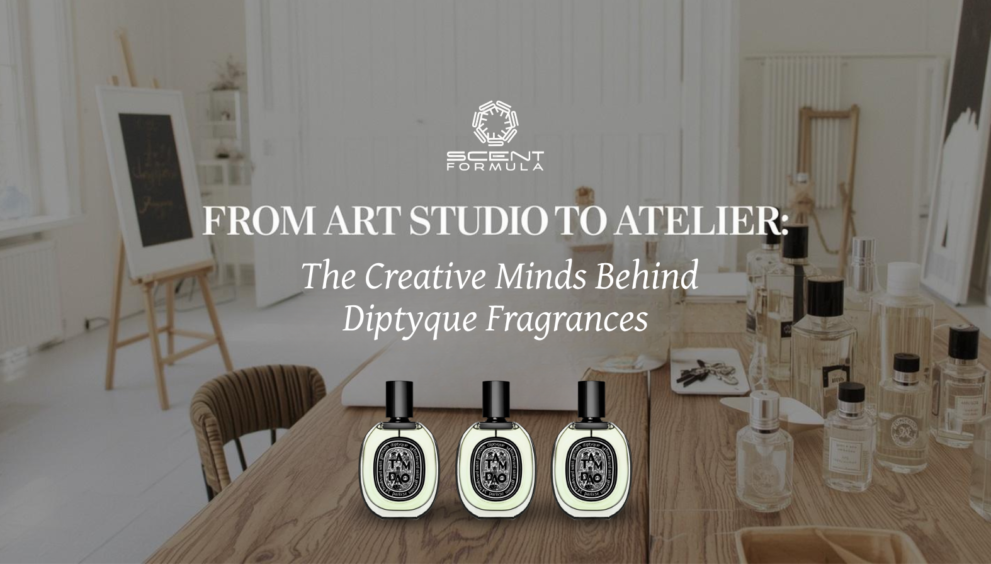
From Art Studio to Atelier: The Creative Minds Behind Diptyque Fragrances

Ever caught a scent and felt instantly transported? Maybe to a quiet spot in a busy city or a special memory from a trip. Scent has that profound power. The founders of a remarkable Parisian house knew this well.

Diptyque started as a group of artists and designers. Their first place was a gallery on Paris’s Left Bank. They brought an artist’s touch to perfume from this creative space.
They saw each fragrance as a canvas, with notes as colours and accords as brushstrokes. This approach makes their scents so evocative and complete. To really get their iconic scents, you need to know the visionaries behind them.
This story shows how a small gallery became a world leader in scents. It’s a tale of art, passion, and beauty through fragrance.
Key Takeaways
- Diptyque was founded by a collective of creative talents in Paris.
- The brand’s origins in an art gallery shape its unique approach to fragrance.
- Their perfumes are conceived as artistic compositions, not mere products.
- Understanding the founders’ vision is key to appreciating the brand’s depth.
- The house treats scent as a powerful medium for memory and emotion.
- Their journey reflects a blend of artistic sensibility and olfactory expertise.
The Artists of Boulevard Saint-Germain: Diptyque’s Founding Vision
In 1961, Boulevard Saint-Germain saw a burst of creativity. Three friends, each with their own talent, came together. They wanted to create a space that showed a beautiful way of living.
These three artists—an interior designer, a painter, and a set designer—brought a fresh view. They were Diptyque’s founders, and their story is the brand’s heart.
1961: A Creative Convergence in Paris
Post-war Paris’s Left Bank was buzzing with ideas. It was here that Christiane Montadre-Gautrot, Desmond Knox-Leet, and Yves Coueslant met. Their collaboration was born from friendship and a desire to create beauty.
“We were artists. We were not driven by ambition, but rather by passion, imagination, creativity and the desire to do something with true integrity.”
Christian Gautrot: The Interior Designer with a Vision for Living
Christiane Montadre-Gautrot, known as Christian Gautrot, was the interior designer of the trio. She made spaces that were both useful and inspiring. She believed objects and spaces should tell a story and make life better.
Her vision was key. It went beyond just decoration to a way of living beautifully. This philosophy was the foundation for their future shop at 34 boulevard.
Desmond Knox-Leet: The Painter’s Eye for Colour and Form
Desmond Knox-Leet, the British painter, brought a deep sense of visual composition. His background was extraordinary, having worked as a codebreaker at Bletchley Park during the war. This detail-oriented, puzzle-solving mind later influenced the brand’s iconic aesthetic.
He created the distinctive, ‘dancing’ alphabet that adorns every Diptyque label. This typography, playful yet precise, is a direct legacy of the painter Desmond Knox-Leet and his unique graphic sensibility.
Yves Coueslant: The Set Designer’s Sense of Drama and Space
Yves Coueslant, the theatre set designer, was the third member. He was a master at creating atmosphere and narrative in a space. He knew how objects could set a scene and evoke emotions.
Set designer Yves had a knack for the dramatic and careful arrangement. His talent made their boutique feel like a stage where every visitor was part of a beautiful story.
Establishing the 34 Boulevard Saint-Germain Boutique
The result of their collaboration was the opening of their boutique at 34 Boulevard Saint-Germain. This address on Paris’s famous thoroughfare became their creative laboratory and public face.
Entering 34 boulevard saint germain was like discovering a treasure. The three friends filled it with treasures from around the world, from antique fabrics to unusual curiosities.
A Revolutionary Concept: Part Gallery, Part Bazaar
The boutique was unlike any other shop of its time. It was neither a standard shop nor a sterile gallery. Instead, it was a revolutionary mix: part curated gallery, part eclectic bazaar.
You’d find rare prints next to exotic spices, and vintage furniture next to hand-painted fabrics. This bazaar-like atmosphere made every visit a unique sensory journey. It was a portal to a world curated by the founders’ impeccable taste.
The Diptych Motif and the Birth of a Name
The physical layout of the boutique inspired the brand’s iconic name. The space was arranged like a diptych—a two-panelled painting common in classical art. Each side of the shop at 34 boulevard presented a different, yet complementary, array of objects.
This diptych motif perfectly symbolised the dualities they celebrated: old and new, local and exotic, visual and olfactory. From this poetic concept, the name Diptyque was born. It was a fitting title for a venture built on the harmonious pairing of three brilliant, creative minds.
From Art Studio to Atelier: The Pivot to Perfume
The trio’s journey started with a desire to enhance their boutique’s ambiance. This led them into the world of perfumery, not by plan but by passion. Their love for imagination and creativity drove this shift from visual arts to the art of scent.
The Incidental Birth of the Scented Candle
The boutique at 34 Boulevard Saint-Germain was a sensory delight. Desmond Knox-Leet, with his keen sense of smell, created fragrances for the space and fabrics. This practice laid the groundwork for their famous candles and perfumes.
From Decorative Fabrics to the First Fragrant Wax
The first scented candle was a happy accident. The founders infused wax with essential oils to fragrance textiles. Their early creations were simple yet groundbreaking, featuring natural waxes and single notes like aubépine, cannelle, and thé.
These candles were not the heavily scented items common back then. Instead, they were subtle, designed to enhance a space rather than overwhelm it. This marked the brand’s entry into functional art for the senses.

Embracing the Olfactory as an Art Form
The founders’ early success with fragrances led them to see scent as their new canvas. They approached fragrance creation with the same creativity and integrity as visual arts. Each scent was a composition to be built and refined, defining their olfactory philosophy.
“We are not perfumers in the traditional sense; we are illustrators of scent.”
This statement encapsulates their artistic ethos. They viewed themselves as artists, translating experiences into fragrance, not as industrial perfumers following formulas.
How Travel and Memory Became the New Canvas
Like painters use sketchbooks, Diptyque founders used travel as inspiration. A dewy garden, a Mediterranean fig tree, or a distant tuberose scent became the basis for their fragrances.
Their approach was deeply personal and narrative-driven. They created fragrances inspired by cherished places. They collected raw materials and memories with equal fervour, creating “olfactory postcards” from their journeys.
Rejecting Perfumery Conventions for Artistic Expression
In the 1960s and 1970s, mainstream perfumery focused on bold, floral, and decadent scents. Diptyque rejected these conventions. They sought authenticity and emotional resonance over obvious sex appeal and marketing trends.
Their first eau de toilette was a radical departure. It told a story rather than just smelling pleasant. This artistic integrity set them apart in an industry focused on mass appeal.
The table below highlights how Diptyque’s artistic approach contrasted with conventional perfumery of their time:
| Aspect | Diptyque’s Artistic Approach | Conventional Perfumery (1960s-70s) |
|---|---|---|
| Primary Inspiration | Personal memories, travel, and natural landscapes | Market trends and commercial appeal |
| Fragrance Composition | Singular, authentic notes and unconventional accords | Complex, often floral bouquets with heavy musks |
| Creative Process | Collaborative dialogue between artist and nose | Perfumer working to a commercial brief |
| Intended Experience | Evoke a specific memory or place | Create an attractive, wearable scent |
| Early Materials | Hawthorn, cinnamon, tea, fig, green notes | Rose, jasmine, vanilla, amber, potpourri-style blends |
This shift from decorating spaces to creating atmospheres made Diptyque an olfactory atelier. Their first eau de and subsequent creations solidified their reputation as true artists of scent. They worked in a medium that engages memory and emotion as powerfully as any visual art.
The Creative Methodology: How Artists Compose Scents
Understanding a Diptyque fragrance means diving into a detailed, artistic process. It’s not just about making scents; it’s a bespoke craft born in an atelier. Each fragrance is a unique piece, crafted with the same care as the founders’ original gallery.
The whole process is a dialogue. CEO Fabienne Mauny says it’s about combining “our skills in creating perfumes with those of artisans and artists.”
The Collaborative Dialogue Between Founder and Nose
Every fragrance starts with a conversation. It could be a founder’s memory of a rainy garden or a sketch of an emotion. This idea is then given to a master perfumer for their special talent.
This partnership is key. The founder shares the vision, the story, and the feeling. The perfumer then interprets and starts the magical transformation.
The Role of the Perfumer as a Sensory Translator
The perfumer is more than a chemist; they’re a sensory translator. They turn a story into a scent. Is the memory warm or cool? Sharp or soft? The answer is in the right notes—a hint of pink pepper, the sadness of vetiver.
This is a delicate art. It needs empathy and skill to bring an idea to life.
The Journey of a Fragrance: From Inspiration to Bottle
Once the vision is shared, the fragrance starts a three-stage journey. It goes from a fleeting idea to a real de parfumbottle. This journey makes every bottle a one-of-a-kind piece of scent art.
Stage 1: The Olfactory Sketch and Story
First, there’s the sketch. It’s like an artist’s first drawing, with scent impressions. Words like “sun-drenched fig tree” and “misty riverbank” guide the selection of core scents.
These words help choose the main notes. The story sets the mood before any raw material is found.
Stage 2: Sourcing and Blending Rare Raw Materials
Next, the ingredients are gathered. Diptyque’s fragrance house searches the world for the finest. They find Bulgarian rose, Somalian incense, and Calabrian mandarin with the care of an artist picking colours.
The quality and origin of these raw materials are crucial. They are the base for the perfumer’s art.
The final stage is refining and balancing. The perfumer mixes the ingredients with sculptural precision. A hint of blackcurrant might be added, or the sandalwood base softened.
This process continues until the perfect balance is found. The final accord is where the fragrance’s chic, complex character is set.
The result is a scent that reflects its entire creative journey. From the first conversation on the rue de pontoise to the elegant typography on its label, every detail shows a unified vision. This method makes wearing a Diptyque fragrance a true experience of wearable art.
https://www.youtube.com/embed/ON3V4YoVDW4
A Gallery of Scents: Diptyque’s Most Celebrated Creations
Diptyque’s scents are more than just perfumes. They are olfactory artworks, each with its own story. They are crafted with artisanal precision. This section is your private viewing of the maison’s most iconic pieces.
You will explore the note breakdowns and cultural impact of three masterpieces. These scents define the artistry of Maison Diptyque.
L’Ombre Dans L’Eau (1983): A Walk in a Dewy Garden
Launched in 1983, L’Ombre Dans L’Eau was a revolution. It translated the vivid, damp greenery of a garden after rain into scent. This fragrance broke conventions with its bold, green character.
Olfactory Notes: Blackcurrant Buds, Bulgarian Rose, and Moss
The opening is a startlingly realistic crunch of blackcurrant buds. It is both tart and dewy. This gives way to the velvety richness of Bulgarian rose, grounded by the earthy depth of moss.
Its Lasting Impact on Green, Unisex Fragrances
This scent pioneered the modern green, unisex fragrance category. It proved that diptyque fragrances could be both intellectual and deeply sensual. Its influence is still felt in perfumery today.
Philosykos (1996): The Essence of a Fig Tree
Where L’Ombre captured a moment, Philosykos captures an entire entity. This 1996 creation is a holistic portrait of a fig tree. It is a landmark in photorealistic scent design.
Olfactory Notes: Fig Wood, Fig Leaf, Milky Sap, and Coconut
You first encounter the green, slightly bitter dustiness of a fig leaf. Then, the creamy, coconut-like nuance of the tree’s milky sap emerges. Finally, the dry, smooth character of fig wood provides a foundation.
A Masterclass in Photorealistic Scent Creation
Philosykos doesn’t just smell like figs. It evokes the tree’s bark, its shade, and the air around it. This technical artistrymakes it a reference point for naturalistic perfumery.
Do Son (2005): A Tuberose from Distant Shores
Inspired by a childhood memory of tuberose in Vietnam, Do Son is about personal history. This 2005 fragrance is intensely evocative. It turns a flower into a vessel for nostalgia.
Olfactory Notes: Tuberose, Orange Blossom, and Musk
The narcotic, almost decadent aroma of tuberose is central. It is softened by the fresh sweetness of orange blossom. A veil of clean musk gives the composition a skin-like intimacy, reminiscent of Fleur de Peau.
Evoking Personal Memory Through Scent
Do Son demonstrates Diptyque’s power to bottle emotion. It shows how sensory experiences are tied to memory. This makes it one of their most personally resonant eau de toilette creations.

To appreciate the distinct vision behind each, consider their core contrasts:
| Fragrance | Central Theme | Key Accord | Perfumery Legacy |
|---|---|---|---|
| L’Ombre Dans L’Eau | A dewy, green garden | Blackcurrant & Rose | Pioneered modern green unisex scents |
| Philosykos | A complete fig tree | Fig Wood & Milky Sap | Masterclass in photorealistic nature scents |
| Do Son | A memory of tuberose | Tuberose & Musk | Evokes personal nostalgia and emotion |
Diptyque in Singapore: Appreciating Artisanal Scents
The brand’s philosophy finds a keen audience in Singapore. Discerning consumers here value craftsmanship, story, and unique sensory experiences. Diptyque’s boutiques are sanctuaries of this art of living.
The Brand’s Presence and Resonance in the Local Luxury Landscape
In Singapore’s luxury landscape, Diptyque stands out for its authentic narrative. It is not just a perfume brand but an artisan of atmosphere. This resonates with locals who seek depth beyond logos.
The global concept of Diptyque Maisons—spaces for inspiration in Paris and London—echoes locally. These are hubs for exhibitions and olfactory workshops. As Laurence Semichon notes, the focus is on deep connection.
“Bespoke consultations, olfactory discovery sessions and sensory experiences allow customers to connect deeply with our products.”
Laurence Semichon
This approach aligns perfectly with Singapore’s appetite for curated, immersive retail. Limited-edition releases and collaborative installations are eagerly anticipated. The brand’s birthplace in an art studio, by designer Yves Coueslant and his peers from the School of Fine Arts, adds a layer of intellectual appeal. It transforms a purchase into an acquisition of artistry, much like choosing a piece of wallpaper or art for one’s home.
Conclusion: An Olfactory Legacy Forged in Art
The story of Diptyque is a testament to artistic vision. It started as a small Parisian gallery and grew into a famous perfume house. The brand’s identity comes from its founders’ belief that life is an art.
Every Diptyque creation is more than a perfume. It’s a bottled story, a sensory memory made through art. The brand aims to bring specific places and moments to life through scent.
This poetic vision continues to shape the future. CEO Fabienne Mauny says the launch of Maisons Diptyque marks a new chapter. “Our new boutiques are immersive locations that celebrate the art of living, Diptyque-style.”
In Singapore, exploring Diptyque’s scents connects you to this heritage. Each fragrance offers a unique sensory experience. It encourages you to see scent as an art form, not just a product.
The legacy of the atelier lives on. Diptyque’s future, from its immersive boutiques to new perfumes, is guided by its original spirit. It makes sure every creation is a true work of art.
Visit ScentFormula to learn more about Diptyque’s.
Frequently Asked Questions
How did the perfume house diptyque evolve from an art studio to an atelier and what does that mean for the art of living?
Diptyque started as a small collective of creatives and slowly became an atelier where craft meets concept. That shift made the brand more intentional about the art of living — fragrances, home scents, and objects that blend everyday ritual with artistic expression.
Who were the three artists involved at the beginning and how did their collaboration shape diptyque’s approach to the art of living?
The original team included three artists who brought illustration, scenography and design together. Their shared taste for quality and storytelling turned simple scents into lifestyle statements, making the art of living central to everything from packaging to perfume composition.
What role did designer christiane and interior designer christiane montadre-gautrot play in creating diptyque’s spaces and how does that relate to the art of living?
Designer christiane and interior designer christiane montadre-gautrot helped translate the brand’s aesthetic into physical spaces. Their work made stores feel like ateliers — layered, tactile, and lived-in — underscoring the art of living as a sensory, spatial experience.
Why is the boutique at 34 boulevard saint so iconic and does it reflect diptyque’s take on the art of living?
The boutique at 34 boulevard saint became a landmark because it embodied diptyque’s blend of intimacy and design. It’s curated like a home, full of objects and scents, which is exactly how diptyque sees the art of living: everyday environments elevated by thoughtful details.
How did diptyque called upon outside collaborators for scent projects and what does that say about their art of living philosophy?
Diptyque called upon perfumers, artists and designers when they wanted fresh perspectives. That collaborative spirit shows their belief that the art of living is collective — a mix of expertise, inspiration and shared taste rather than a lone signature.
Are diptyque’s fragrances only eau de parfum or do they include other formats, and how do those choices support the art of living?
They make everything from eau de parfum to candles and home sprays. The de parfum concentrates deliver personal scent, while candles and potpourri create ambient layers at home — all tools to practice the art of living through fragrance.
How are the scents inspired by the scents of places and memories, and does that tie into diptyque’s studio-to-atelier story and the art of living?
Many diptyque perfumes are inspired by travel, gardens and neighborhoods — little snapshots of memory. That storytelling links back to their studio roots: turning personal impressions into crafted objects, a core part of the brand’s art of living ethos.
Is there a signature object or ritual from the atelier that fans can bring into their home to experience diptyque’s art of living?
Absolutely — besides the perfumes and candles, simple rituals like a potpourri bowl, layering a candle with a diffuser, or keeping a small bottle of parfum on a vanity reflect diptyque’s idea that the art of living is about everyday, elegant small acts. For a true atelier touch, recreate a vignette like the original concept store displays.